
You're Optimizing for Efficiency. You're Losing Your Future Leaders.
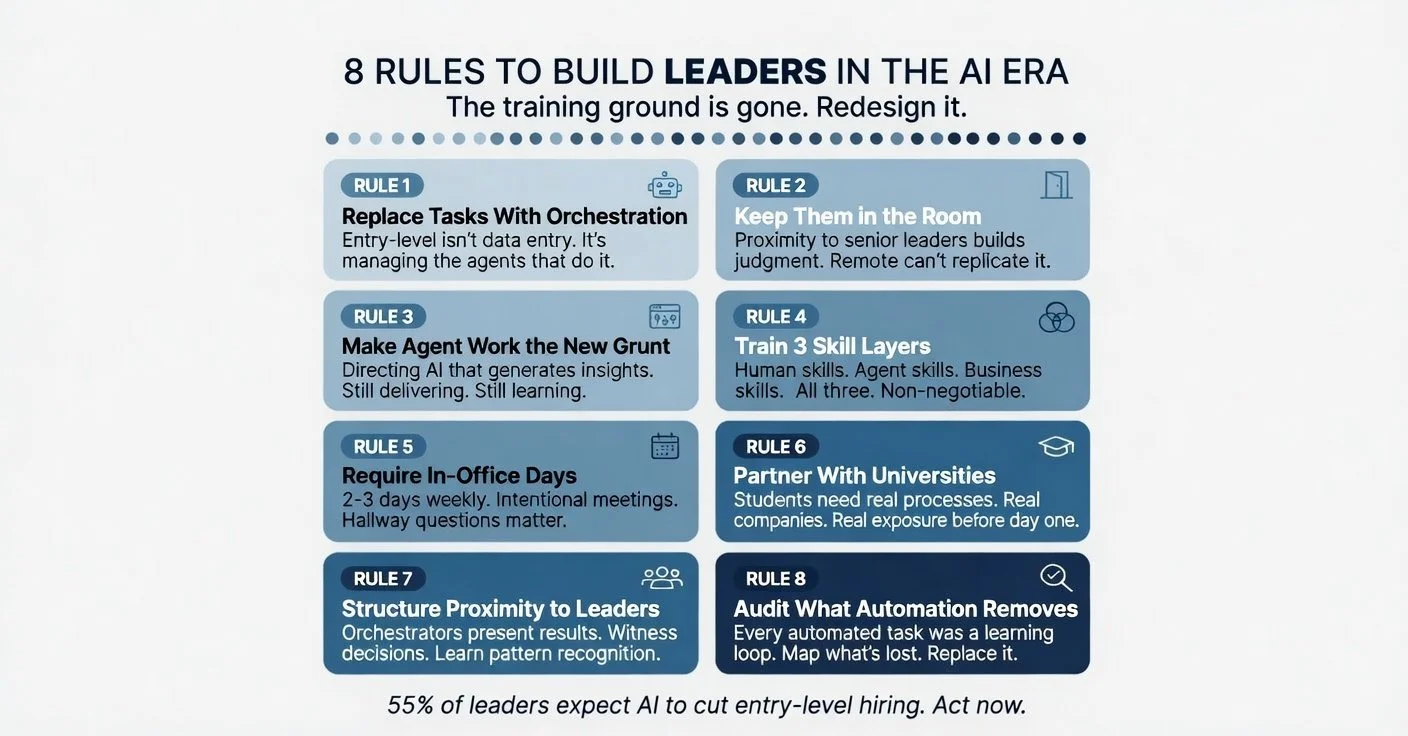
I've been tracking the research on how entry-level work is transforming.
The pattern most people are missing: this isn't about job elimination. It's about the fundamental nature of "entry-level" becoming obsolete.
Companies are gaining efficiency. They're reducing cycle time and errors. They're getting faster results.
But they're missing something critical.
You're losing the training ground for your next generation of leaders.
The Learning Loop We're Breaking
I remember watching a senior leader look at the same data I had and draw a completely different conclusion.
It was mind-blowing.
What made that moment transformative wasn't that they were smarter. It was that through experience, they could connect patterns I couldn't see yet. They'd witnessed that fact pattern play out before.
If you don't witness it, you can never be it.
That's the paradox we're facing. The mundane, grueling work that put young people in the room to observe those moments is disappearing.
Stanford's WORKBank study surveyed 1,500 workers across 104 occupations. Workers want AI agents to automate 46.1% of their tasks.
The top reason? Freeing up time for high-value work.
But here's what the data doesn't capture: those repetitive tasks were how young people learned grit. How they saw senior executives turn their grunt work into strategic decisions. How they got tougher through responding to changing business needs.
Without that exposure, you risk not building your next level of leaders.
What We're Actually Losing
When you do data entry or pull together reports as an intern, you learn something subtle.
You see how hard it is to aggregate results. You watch executives use what you compiled to make decisions. You get exposure to leaders who translate your work into complex ideas.
You learn through that process.
McKinsey's research shows that 60% of occupations could see one-third of their tasks automated. But the research emphasizes role evolution, not job elimination.
The problem: entry-level roles concentrated those automatable tasks. They bundled them together as a training ground.
Gartner reports that 55% of supply chain leaders expect agentic AI to reduce entry-level hiring. Broader data shows a 35% decline in US entry-level jobs.
This isn't speculation. It's happening now.
The Opportunity Hidden in the Disruption
You need to rethink work entirely.
Young people can't do the grunt work anymore. But they can become orchestrators of the agents doing that work.
Orchestration keeps them in the room.
They're not doing data entry. They're managing the agents that aggregate data. They're not pulling reports. They're directing the AI that generates insights.
But they're still the extended workforce of senior leadership. They're still presenting results. They're still witnessing how experienced leaders think.
Salesforce research identified 10 essential skills grouped into three categories:
Human skills: adaptability, emotional intelligence, collaboration
Agent skills: AI literacy, human-agent collaboration
Business skills: problem-solving, critical thinking, data interpretation, storytelling
Success requires mastery across all three. Not just technical competency.
Why Physical Presence Still Matters
Remote work is great for heads-down work. For presentations. For training sessions.
But young people need to be in the room.
If we learned anything from the Zoom era, it's this: material comes through digitally. Connection and real human interaction don't.
Relationships get built in person.
You need coffee in the hallway. You need to sit next to someone and lean over to ask a question when you're confused in a meeting. You need the eye contact that shows you don't understand something.
Slack formalizes questions. It distracts everyone from the meeting. Some people won't have the nerve to ask because it feels like admitting they're lost.
But in person? You can write something down on a piece of paper. You can point to a slide after the meeting. You can have that hallway conversation with someone you trust.
That human connection cannot be replicated digitally.
You can somewhat meet the need remotely. But you're missing the relationship building. You're missing the moments where vulnerability turns into learning.
Designing Programs That Build Leaders
You need to acknowledge that early-career people come in with potential, not complete knowledge.
If you don't ask questions, you don't learn.
Curiosity is key to advancing.
You encourage failing forward. You encourage trying things. That emotional comfort and vulnerability comes from in-person human connection.
That's how people advance. That's how they take risks. That's how they learn, get up, get comforted, and keep moving.
The ideal entry-level program today looks different than three years ago:
Two to three days in the office per week
Very intentional in-person meetings
Working directly with team members
Supporting delivery on actual business functions
Orchestrating agents while learning the business context
But here's the harder work: you need to dissect what entry-level actually means now.
What Universities and Companies Need to Do
Young people need to understand the science of work in their chosen industry.
They need exposure to real companies. Real processes. Real results.
They need to see how the sausage is made.
You can't orchestrate agents effectively if you don't understand what processes drive results. What data inputs matter. What market factors influence outcomes.
It's more important than ever to create connection points between students and actual business operations.
Universities need to equip students to walk in the door as orchestrators. To participate above the grunt work level while still delivering results.
Companies need to tackle this industry by industry. You need to define what new talent looks like. What those new jobs require. What prerequisites matter.
Universities need to prepare students to meet entry-level experiences where they are now, not where they were.
The Challenge Ahead
This is a new problem that varies wildly by industry and function.
But the core tension is the same everywhere: how do you train tomorrow's leaders when the traditional learning loop is broken?
You can't just automate the tasks and hope young people figure it out remotely.
You need intentional programs.
Programs that put orchestrators in the room with decision-makers. That create structured opportunities to witness how experienced leaders think through ambiguity. That build the human skills AI can't replicate.
Decision-making under uncertainty. Emotional intelligence. Communication nuance. Complex problem-solving.
These skills develop through proximity to people who've done it before. Through watching fact patterns play out. Through building relationships where vulnerability feels safe.
The efficiency gains from AI are real. The cycle time reductions matter. The error reduction creates value.
But if you optimize for those metrics alone, you'll wake up in five years without a pipeline of leaders who know how to do the work.
The opportunity is to redesign entry-level work around orchestration while preserving the learning pathways that build judgment, grit, and leadership capacity.
That redesign starts with recognizing what we're actually losing - and getting intentional about replacing it.
